
Key quotes in line with the #BlackLivesMatter movement:
Immigration is an inherently intersectional issue, affecting people of any background. That is not to say that people of differing backgrounds receive the same treatment,29 but rather that the struggle for liberation in the immigrant rights movement is inherently tied to other struggles for liberation, including the Movement for Black Lives and the movement to defund the police.30 The movements for abolition of the police, prisons, ICE, and immigrant detention are inherently intertwined.31 ICE and CBP operations mirror those of the U.S. police in many ways, including in the prevalence of abuses committed against people in their custody, the targeting of Black and Brown people, and the huge quantity of taxpayer money put towards these militarized systems of oppression that could otherwise be used to support community services. Furthermore, multiple organizations focused on Black liberation explicitly identify the end of immigrant detention as a policy demand.32 Ending family detention minimizes harm wrought against multiple communities at the hands of the U.S government, and insofar as multiple movements for liberation call for abolition of detention, family detention is an obvious immediate target.
The unique role the United States has played in contributing to the root causes of immigration from Latin America must also be acknowledged. The violence immigrants flee, particularly in Guatemala, El Salvador, and Honduras, is rooted in U.S. intervention and exploitation. The United States backed military coups and dictatorships that committed massacres and other atrocities against innocent civilians, including genocide like the mass physical and sexual violence attempted against the Maya in Guatemala. The impunity Central America struggles with today is largely rooted in these years of violence. The present narrative surrounding immigration is egregiously estranged from the reality of the United States’ history in Latin America; in March, 2019, the president cut off about $500 million in aid to Guatemala, El Salvador, and Honduras.33

-Angela Valenzuela
#AbolishFamilyDetention
#BlackLivesMatter
#OpposeFascism
“THE U.S. GOVERNMENT KIDNAPPED MY SON”
SURVIVING FAMILY SEPARATION AND PROLONGED FAMILY DETENTION:
A REPORT ON THE FAMILIES OF KARNES
CONTENT WARNING: This report includes the following topics: family separation, detention, torture, sexual violence, death, suicide, genocide, mistreatment of indigenous communities, and abusive behavior by those in positions of power.
INTRODUCTION
On April 6, 2018, then-Attorney General Jeff Sessions announced that the Department of Justice would seek to criminally prosecute migrants who crossed the southern border outside of ports of entry, an action for which prosecution is typically discretionary. In practice, this policy provided the legal basis for the Department of Homeland Security to forcibly separate children from their parents. Children were ripped from parents while parents were referred for criminal prosecution for crossing the border without prior authorization, even though many families fled to the U.S. to seek asylum. It is legal to seek asylum when in the territory of another country under both U.S. and international law. The affected families primarily migrated from Guatemala, Honduras, and El Salvador. 1
The U.S. government has been found to repeatedly misrepresent data on family separation, with the number of families separated originally reported as 1,556.2 However, as of October, 2019, that number was estimated to be over 5,400, though some of that increase may be due to continued, illegal family separations.3 To date there is no definitive count of families separated by the policy, nor of children who still remain separated from their parents. Reports estimate at least 300 children were yet to be reunified as of 2019.4 At least 471 parents were deported without their children as a result of the inhumane policy.5 In the words of U.S. Judge Dana Sabraw, who oversaw the family separation case Ms. L v. Sessions, “The reality is that for every parent who is not located, there will be a permanently orphaned child, and that is 100% the responsibility of the administration.” 6
This report intends to illuminate the experiences of the 278 families who were separated and subsequently detained at the Karnes family detention center (“Karnes”) in Karnes City, Texas. The Karnes Pro Bono Project, under the auspices of RAICES, offers free legal services to people detained in Karnes under a universal representation model. This meant that any formerly separated family at Karnes could seek legal services from RAICES until they were released from detention. Many families also continued to receive services from RAICES after their release. Because of the universality and scope of services offered, RAICES, through the work of the Karnes Pro Bono Project is uniquely positioned to comment on the issues of families detained in Karnes.
After months of separation, fathers and sons remained in detention together in Karnes, fighting their immigration cases. The following report of experience aims to illustrate in detail how family separation and detention are unacceptable policies. Additionally, this report attempts to add to the public record of atrocities committed against migrant families in the ongoing fight for immigrant justice. Finally, this report seeks to elevate the voices of formerly separated families who bravely spoke out against prolonged family detention based on their own experiences in response to the Trump administration’s ongoing attempts to expand family detention and family separation.

SEPARATION
Families separated under the Zero Tolerance policy crossed the U.S. southern border in spring of 2018, and were then separated for long periods of time ranging from forty-five days to six months or more. The average length of separation was 52 days. At the time of their separation, children who were reunited to be detained with their fathers in Karnes ranged from four to seventeen years old. Families were separated in Customs and Border Protection (CBP) detention facilities known as the “hieleras” and “perreras.”7 Parents reported a variety of situations surrounding the initial separation from their child. One father recalled officers told him they were taking his seven-year-old son for a bath, mirroring tactics of the Nazis in the Holocaust. 8
A father recalls officers deceiving him when they separated him from his son, telling him they were only going to bathe the child.
After these separations, parents were sent to various, often multiple, adult prisons and immigration detention centers across the U.S. There was no uniformity in the way that children’s cases were processed, and children were transported to various sites around the United States. While separated, most families reported having little to no contact with each other. They did not know where the other was. They did not know if the other was detained, deported, or released into the United States. Fathers often reported squalid conditions in federal prison or adult immigrant detention centers, including being made to eat while chained at the ankle, waist, and wrists. Some families were able to speak on the phone once or twice during the months of separation. The conversations were typically limited to two to ten minutes.
One father recalled being able to speak to his son for a few minutes after a month with no contact and no word on where he was. He was only able to speak to his son because his family outside of detention helped him find him; the government did not respond to his requests to locate him.
Many families had no idea if, when, or where they would be reunified until it took place. On July 15, 2019, the first twelve families reunited at Karnes arrived. Many parents had just been reunited at 4:00 in the morning after months without contact with their children and with no warning that they were about to be reunited. Within about a week the population at Karnes swelled to several hundred formerly separated fathers and sons, with cases in a wide variety of legal postures.
On average, formerly separated families spent 68 days detained in Karnes after reunification, bringing the average total length of time in immigrant detention to 120 days. The last family of the hundreds of families who arrived in late July would not leave Karnes until December 27, 2018, some five months after reunification. The atrocities the U.S. government inflicted on these families did not end with their reunification, as they continued to face the harm inherent to detention for months on end afterwards.


AFTERMATH OF REUNIFICATION
Almost all reunified families at Karnes originally came to the U.S. to seek asylum. Families underwent the long journey to the United States fleeing torture, death, sexual violence, and other forms of persecution, and when they thought they finally reached safety they then faced irreparable harm at the hands of the U.S. government when it forcibly ripped children from parents. For asylum seekers, deportation is often a life or death situation. So, despite not having seen each other in months and still being in the hands of the very government that separated them, families promptly met with lawyers to try to assess their legal options. Many parents already had negative fear determinations due to interviews conducted while separated from their children, meaning they awaited imminent deportation.9 Others had already completed the entire “removal proceedings” immigration court process and had lost their asylum cases. As such, many faced potentially imminent deportation.
While completing legal intakes, parents and children were shocked to discover more about what happened to each other while separated. RAICES staff recalled asking parents about what medical care their children received during legal intakes. Parents often had to call their children over to ask them whether or not they had been injected with anything while separated, and would then learn that officers had indeed injected children with unknown substances. No government officials had notified them that this occurred.
After bringing their paperwork to attorneys many parents also learned they had signed their deportation orders. Officers instructed many fathers to sign all-English forms in order to be reunited with their children, but did not explain that these forms authorized their deportation.
After the ordeal of separation, many families in Karnes expected to be rapidly released from detention; many of them because officers told them they were about to be freed after they were reunified. Some did get out quickly, primarily because they had not triggered the asylum process until they arrived at Karnes despite being in detention for months.10 Unfortunately, many did not get out quickly, as their cases depended on a settlement agreement in the Ms. L v. Sessions case in order to move forward. In the meantime, families were detained indefinitely, a practice known to cause profound harm.11, 12
PAVING THE WAY FOR INDEFINITE FAMILY DETENTION
In total, formerly separated parents and children spent at least approximately 34,900 days in Karnes. Judge Dana Sabraw, who oversaw the Ms. L case that ordered the reunification of families affected by the Zero Tolerance policy, ordered a stay on deportations of formerly separated families in late July, 2018 and issued a longer stay again in August, 2018 until a settlement agreement could be agreed to. This was a blessing and a curse. It meant the threat of immediate deportation no longer loomed, but it pushed families into legal limbo while detained. Families’ asylum claims depended on the results of the settlement agreement in court, but their continued detention did not. The power to release families from detention remained with ICE.13
Of the formerly separated families in Karnes who continued on into the U.S., 97% of them reported having a sponsor in their intake documents with RAICES. This does not mean that the 3% of families who did not report their sponsor information had no sponsor; it merely indicates that the information was not recorded. Thus, the actual percentage of families who did not have sponsors may be even lower. ICE chose to subject families to indefinite incarceration even though nearly all of them had loved ones waiting to receive them in the United States.
The Flores Settlement governs the circumstances under which the U.S. government can legally detain minor children.14 Under Flores, children should not be detained for more than 20 days except under emergency circumstances. In 2018, families arriving at the southern border to seek asylum would typically spend about 14 days in Karnes prior to being released to their sponsors in the United States to continue with the asylum process.
However, families in Karnes had to give up their children’s Flores rights in order to be reunited under the Ms. L settlement, though many did not understand what this meant nor receive an explanation. They would then come to know and advocate for the importance of their rights under Flores as they suffered months in detention. Families dependent on the settlement agreement to resolve their cases had to watch as countless families who were not separated under the Zero Tolerance policy passed through Karnes in a matter of days or weeks, all while they remained detained indefinitely. Fathers had to try to explain this to their wondering children, despite having no answers for themselves. Many expressed that their children would ask them “papa, when will we be freed?” nearly daily.
A father recalls the joy he felt in being reunited with his son, only to discover that they would be indefinitely detained.
After inflicting irreparable harm onto migrant families with separation, the U.S. government continued to harm them with detention. The legal system failed families dependent on the settlement as they felt forgotten and, with each passing day without news in detention, more and more hopeless. The reality of settlement agreements playing out in a courtroom does not translate to someone detained with a child they are unable to parent and protect because of their incarceration. Although ICE had the discretion to free families, the government chose not to. Ultimately, all the suffering formerly separated families underwent in detention at Karnes was arbitrary.
The GEO Group is the U.S. based private prison contractor that ICE contracts to run Karnes. GEO, one of the largest for profit prison companies in the world, administers daily operations at Karnes. According to the ICE budget from fiscal year 2018, the cost of detaining someone in a family detention center is $319.37 per bed, per day. As families spent approximately 34,900 days at Karnes collectively after reunification, the U.S. government spent at least approximately $11,146,013 on the detention of formerly separated families. There is no current publicly available contract for Karnes, so advocates cannot confirm how much of this money goes towards the private GEO group. Regardless, the situation of formerly separated families detained at Karnes is demonstrative of how much money the U.S. government is willing to spend on committing atrocities against migrants even in the immediate aftermath of something as horrific as family separation.
THE ISOLATION OF DAILY LIFE IN FAMILY DETENTION
“THE TRUTH IS, THIS IS A TORTURE THAT HAS BEEN IMPOSED ON THEM. TRUTHFULLY THIS HAS BEEN A PRISON, A LIVING HELL, FOR ALL OF OUR LITTLE ONES.” – A father speaking on family detention who was detained for four months in Karnes after separation and reunification
In Karnes, fathers faced the pressure to heal from the incomparable harm of separation, fight the life or death threat of deportation for themselves and their sons, resist the traumatization and harm of detention for themselves and their sons, and to support their families back home-an equally life or death situation.
Families waiting for the settlement agreement faced the isolation of detention. Karnes City, Texas, is 55 miles southeast of San Antonio, the nearest major city. In the rare event that families had loved ones who could visit them, the rural location of the detention center provided an added barrier to the outside world.15 The remaining alternative was to speak to family in the U.S. and abroad by phone, with families reporting that calls in Karnes cost about $8.00 – $9.00 per minute from a for-profit phone company. People can work for $3.00 a day while in Karnes, usually involving manual labor like cleaning the facility. Money from work could go to making a call to children’s mothers and other missed family, or other goods like food from the commissary for the children. Most families were desperate for the chance to connect with the outside world. The strain and depression of months in detention showed when, as the months went on, detained families would sometimes turn down the chance to make a call, saying “what do I have to say to them? I don’t know when my son will be getting out.”
For many families, conditions in detention became so unbearable that they sought deportation for the sake of their children’s mental and physical well-being. Alluding to the emotional separation he felt from his son since their physical separation and continued detention, one father said, “at least [if I return to my country] I will have the love of my son with me. That is the most important.” Another father put it more directly, saying that while he remained afraid to return to his country of origin because he had been severely beaten and threatened with death for his political opinion, he preferred to ask for deportation because he was afraid his son would die if they continued to be detained. His son had been losing weight for weeks, and the father said he felt he had no ability to care for his son in a detained setting. When he asked officers what was happening with his son’s health, they gave him no answers. It speaks volumes to the conditions of detention and separation that families were willing to seek their deportation, despite fleeing to the United States to seek asylum.
In addition to the pressure to get their children and themselves out of the void of indefinite detention, fathers struggled with the inability to care for family that remained in their home country. Multiple fathers left behind children, pregnant partners, sick relatives, and other dependents. They never anticipated being plunged into legal limbo, incomunicados, for months.
One father expressed not knowing what to tell his pregnant wife when they spoke on the phone. As the weeks of waiting to be deported turned into months, he said he felt pressured to lie to her because her worry for him and their son was affecting the pregnancy, but as a religious man he felt horribly guilty for lying.
Although he was the one suffering detention, one father was so concerned for his family’s well being that he would repeatedly seek emotional support from RAICES staff. His wife and children back home were starving. They were out of corn and savings, and this man, his family’s main provider, was stuck in detention with no end in sight. The father expressed how guilty he felt for being detained when his family needed him, though he was utilizing every avenue at his disposal to try to secure his deportation and get back to them. He repeatedly wept, lamenting, “my children are suffering from hunger, and it’s my fault.” Many fathers expressed the same sentiment.
A father describes how being detained impacted his ability to parent his son.
IMPACTED COMMUNITIES: INDIGENOUS FAMILIES
Out of the approximately 278 families reunited and detained in Karnes, at least 97 of them spoke an indigenous Central American language as their primary language. That is more than a third of the total population of separated families who ended up in Karnes. A significant number of families came from Ixil, Kiche, Mam, Q’anjob’al, and Q’eqchi’ communities in Guatemala. Indigenous communities in Guatemala have outlasted centuries of oppression, facing state-backed genocide as recently as the 1980s that was in part armed and trained by the United States.16 Many families fled Guatemala due to persecution on account of their indigenous identities only to face a system utterly unequipped to provide them justice. The U.S. government consistently fails to provide interpreters and culturally competent materials for indigenous language speakers, and many are shunted through traumatic asylum interviews and deportation proceedings in Spanish despite speaking limited to no Spanish.
In the following audio, a father describes his Q’eqchi’ speaking son’s experience of being hospitalized while they were separated. His son, alone without his father, received no care or information in his own language.
A Q’eqchi’ father describes his son’s isolation due to language barriers while separated.
The government acted with particularly reckless violence when it separated indigenous children from their parents.17 In addition to the inherent isolation of detention, indigenous language speakers face the added weight of linguistic isolation. Linguistic isolation is not only a grave violation of human dignity, but outright dangerous if, in the case of emergency, detained children or adults cannot be communicated with.
THE DETRIMENTAL HEALTH EFFECTS OF FAMILY DETENTION
A father describes the irrevocable effects of detention on his son.
Families’ physical and mental health deteriorated throughout their months in detention. For example, many fathers reported their children were losing weight because they could no longer eat the same food day after day. Fathers also reported losing weight themselves and losing the will to eat. In addition to families’ own statements, RAICES staff witnessed the physical deterioration of fathers and sons as families became visibly more skeletal and ashen yellow in skin color. Multiple fathers, many of them not yet thirty years old, began balding from the stress of detention.
Multiple families tried to access medical care at Karnes and were unable to receive the care they needed. For example, one father brought his son into the medical center after an accident playing soccer and the officers brushed it off, telling him it was just a “golpe,” or a “hit” or “knock.” They called him the next day to perform x-rays and discovered a bone was broken.
A father describes how officers denied his son adequate medical care when he broke his bone in Karnes.
Nearly every single formerly separated family reported mental health problems to their attorneys and legal assistants while detained in Karnes. Both fathers and sons reported having nightmares, with multiple fathers reporting they found their sons crying or calling out for them in their sleep. Countless families reported feeling depressed, anxious, and desperate. In the words of one father, “I want to put my head through a wall” from the pressure of detention.
Some fathers used euphemism to ask if their children would gain freedom if a father killed himself. Many fathers reported contemplating suicide. Multiple children also reported wanting to kill themselves. Multiple fathers who expressed suicidal ideation asked RAICES staff what would happen to their children if “something” happened to the father and he was no longer there.
Today, fathers and sons alike report ongoing struggles with mental health post-detention. Fathers say that, while their sons have recovered some now that they are out of detention, they will never be the same. They will carry this trauma with them for their entire lives. Despite the stigma around mental health, multiple fathers report paying for private mental health services for their sons due to ongoing trauma, with multiple fathers recounting that anytime their children see the police, they panic because they fear the police will take away their fathers. Others report they want to access mental health services at least for their children but do not have the financial means.
Fathers reflect on the lasting impact of detention on their children’s mental health.
RESISTANCE
Despite the circumstances forced upon them, fathers and sons alike resisted. Within their first two weeks reunified in Karnes, families mobilized. They organized a demand letter and began to peacefully protest for their freedom, having already spent months detained while separated.
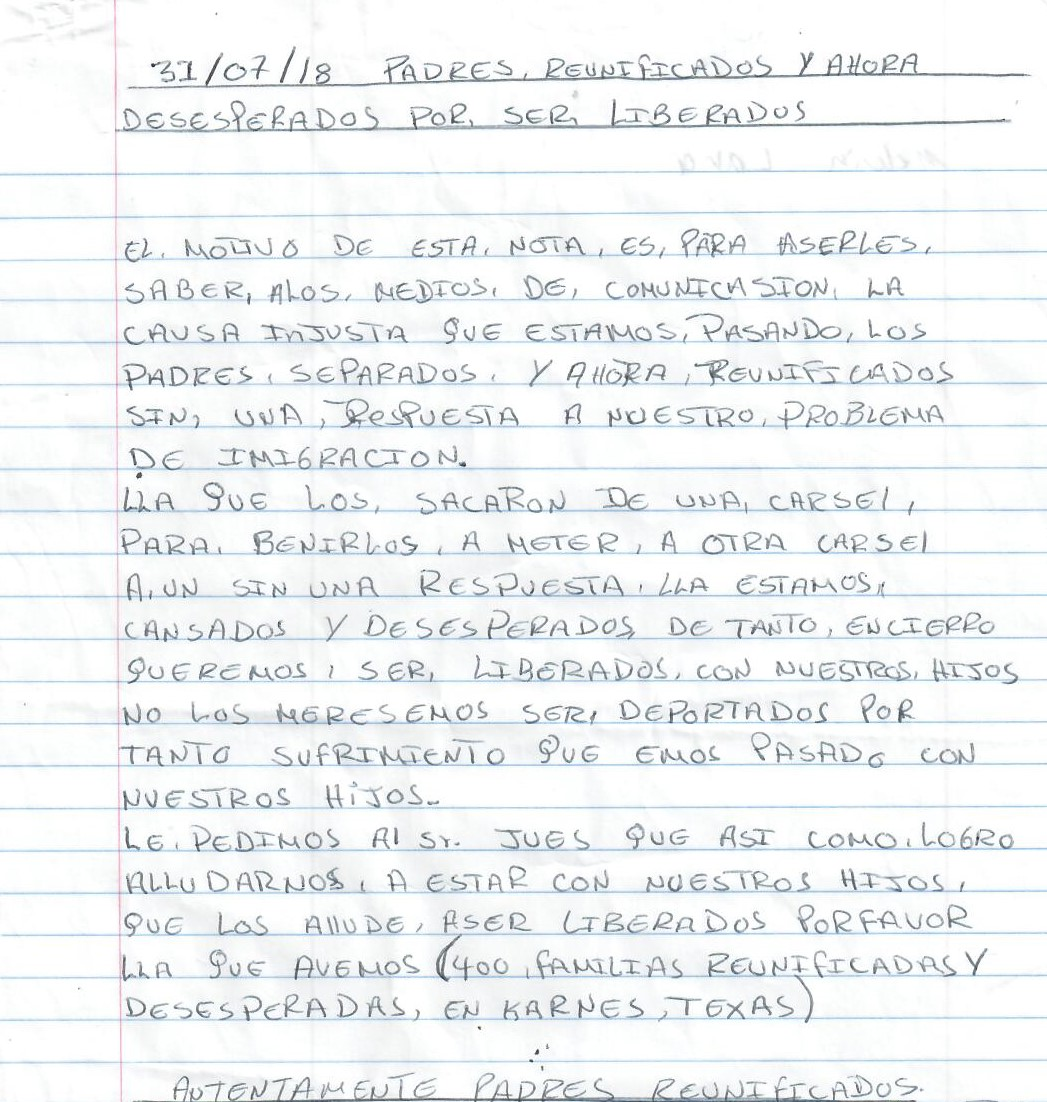
On August 15, 2018, the very day families planned to hold a strike, more than fifty guards armed with bulletproof vests, shields, knee pads, boots, helmets, tear gas equipment, and guns forcibly re-separated 16 fathers from their sons. Some fathers were ripped from their beds while sleeping. Fathers were transported to another facility, where they reported squalid conditions. Some recounted vomiting blood and shaking uncontrollably, and one father even attempted to take his own life. Fathers and sons were told they would never see each other again.
Many families in Karnes saw the re-separation as a warning. It was their worst fear imagined: to be separated from their children once more. Despite this, families in Karnes continued to resist. RAICES staff first learned what happened in the re-separation from other families in Karnes who dared to speak out despite the culture of intimidation. With their help, attorneys were able to begin to piece together what happened and try to support the affected fathers and sons. RAICES, Arent Fox LLP, and Aldea PJC have since filed suit against The GEO Group on behalf of 13 of the 16 re-separated families. To read the complaint, click here.
The 16 re-separated families were reunited in Karnes after more than a day of terror. They met with RAICES staff and quickly began to advocate for themselves and the rest of the families detained in Karnes. Fathers and sons spoke to the press about the horror that was inflicted upon them and to highlight the fight of all families in Karnes: how they felt isolated, forgotten, and desperate to get out. They uplifted the stories of others, speaking out about how another father’s son had expressed his desire to kill himself to illustrate why all families in Karnes needed to be freed.
Many families desisted from participating in the protests upon seeing that, even with flimsy justification, authorities were willing to re-separate families. Others continued to protest, with some fathers hunger striking for days in a row to demand their and their sons’ freedom.18
Authorities in Karnes continued to meet protest with intimidation. For example, on one day families planned to protest, independent community protesters gathered outside of Karnes to make noise so the families could hear that they were not alone. Fathers speaking to advocates on the phone from within Karnes reported GEO guards turned up music inside the detention center when protesters chanted and sang so the detained families could not hear the support.19
GEO also consistently intimidated families with administrative citations. GEO guards would cite families for doing almost anything. One father recounted how he was carrying his son because he was sick. It was raining, and a rain gutter released water onto one part of the sidewalk. The father walked around the rainfall, stepping off of the sidewalk, to try to save his son from growing sicker. A guard chastised him and cited him for stepping off of the sidewalk. Families were made to believe that these citations would show up in their records, prejudicing their asylum claims. In reality, the citations have no bearing on their immigration claims. The atmosphere of intimidation influenced nearly every little action that families took in Karnes.
Despite the valid fear of reprisal, multiple families spoke out to the public about their indefinite detention. Families interviewed with The Guardian and met with actress and activist Alyssa Milano when she visited Karnes.


Furthermore, families wrote letters advocating against the expansion of family detention. The Flores Settlement governs the period of time and conditions under which children may be detained in the United States, until the time at which the government creates regulations that satisfactorily meet the spirit of the settlement agreement. As the government was being held to account for separating then detaining children, the government promulgated proposed regulations with the intent to replace the Flores Settlement Agreement. As part of this process, the government accepted public comments on the proposed regulations as it held children in indefinite detention. Though fathers at Karnes knew their words would have little to no effect on securing their own release, they wrote letters to urge the government not to expand family detention for those who would migrate in the future. To this day, the rights conferred under the Flores Settlement Agreement remain under threat from the Trump administration’s continued efforts to expand family detention.21

SOLIDARITY
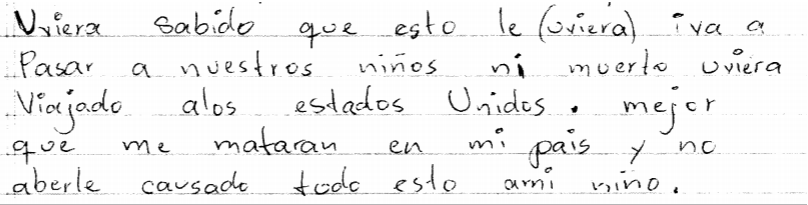
Families helped each other survive detention. Lawyers are unable to take action without knowledge of what is happening to their clients. Time after time, families spoke up for each other despite living in an environment of constant intimidation and trauma.
One father suffered a life threatening health episode and was taken to the hospital away from his son. Fathers in Karnes helped RAICES staff discover his identity, which allowed attorneys to speak to the father in the hospital and look into the wellbeing of his son. Fathers in Karnes even called the man’s family to let them know what happened. On that call, they learned that ICE had not given the man’s family any notice of his hospitalization. The father recovered, and once he was out of the hospital he was reunited with his son, but remained imprisoned at Karnes.
Multiple families also reached out to RAICES when one father seriously considered attempting to take his own life in Karnes. The only reason RAICES staff was able to connect the father with additional mental health support is because other fathers raised the issue.
Indigenous language speakers who spoke more Spanish than others of the same linguistic community also assisted each other in orienting themselves on their legal situation. Furthermore, they taught RAICES staff words in their languages in the hopes of benefiting indigenous families detained in Karnes after they were gone.
Multiple families report staying in contact with each other after gaining their freedom, with many stating that, after what they went through together in detention, they are all family.
CONCLUSION
A father describes how his son gave him the strength to survive detention.
When the Ms. L Settlement Agreement was finalized, it offered some families new fear screening interviews in an attempt to rectify the harm of having forced families to explain their cases to government officials while separated from each other. Of the almost 300 families separated by the Zero Tolerance policy and subsequently detained in Karnes, about thirty families took part in the new asylum interviews offered to them as part of the settlement agreement. Every family interviewed received a positive fear determination. Families released into the U.S., with or without the settlement agreement, then faced navigating the rigid and obscure immigration court system. Despite all they went through, families did not gain asylum upon leaving detention. They are now in deportation proceedings, and may still be deported if their asylum claims are denied. Asylum claims were denied at a rate of about 65% in 2018, with that percentage having increased every year for the past six years.22 Many separated families sought and received deportation before ever entering the U.S. beyond detention, wanting nothing to do with the country that irreparably harmed their entire families. Overall, the suffering families endured under the Zero Tolerance policy and in family detention was utterly avoidable. Nothing mandates family separation, and it should never be reinstituted as a policy. Likewise, family detention is an unnecessary, cruel practice that should be abolished.
Though horrific, the Zero Tolerance policy was by no means the first instance of the U.S. government separating families. While widespread family detention as a practice was only recently reinstituted under the Obama Administration, this country has a long history of separating and detaining Brown and Black families.23 The public cannot forget slavery, genocide and forced assimilation of indigenous communities, and Japanese internment. The modern U.S. prison system continues to separate families, which disproportionately impacts Black and Brown communities. In the current immigration context, nearly every time a person is detained or deported, a family is separated because community ties are severed. Separation at the border and separation from loved ones anywhere else in the migration process are different iterations of the same injustice. It is policy that family members not legally recognized as nuclear family, and children over the age of 18 who migrate together face separation: grandmothers from grandchildren, aunts who have raised nephews like their sons, brothers from brothers, etc. Even before, and now following, the Zero Tolerance policy, parents and children may still face separation, with reports of this separation increasing at the border, and officials threaten families with separation even when they are detained together.24, 25, 26 In the spring of 2020, officials at the three family detention centers presented families with an impossible choice. Parents were asked, despite the inherently coercive nature of their detention, if they would like to waive their Flores rights and agree to indefinite detention under the COVID-19 pandemic or if they would agree to be separated from their children.27
Though the families affected by the Zero Tolerance policy in 2018 were predominantly non-Black Latinx or indigenous, family detention and family separation do not only affect non-Black Latinx and indigenous peoples. In 2020’s new iteration of family separation,28 nearly half of the families threatened with separation at Karnes were Black. About half of the detained population at Karnes for the first half of 2020 has been Black, with roots in Haiti, the West African countries of Angola, the Congo, and Sierra Leone, and Afro-Latinxs communities in Latin America. Immigration is an inherently intersectional issue, affecting people of any background. That is not to say that people of differing backgrounds receive the same treatment,29 but rather that the struggle for liberation in the immigrant rights movement is inherently tied to other struggles for liberation, including the Movement for Black Lives and the movement to defund the police.30 The movements for abolition of the police, prisons, ICE, and immigrant detention are inherently intertwined.31 ICE and CBP operations mirror those of the U.S. police in many ways, including in the prevalence of abuses committed against people in their custody, the targeting of Black and Brown people, and the huge quantity of taxpayer money put towards these militarized systems of oppression that could otherwise be used to support community services. Furthermore, multiple organizations focused on Black liberation explicitly identify the end of immigrant detention as a policy demand.32 Ending family detention minimizes harm wrought against multiple communities at the hands of the U.S government, and insofar as multiple movements for liberation call for abolition of detention, family detention is an obvious immediate target.
The unique role the United States has played in contributing to the root causes of immigration from Latin America must also be acknowledged. The violence immigrants flee, particularly in Guatemala, El Salvador, and Honduras, is rooted in U.S. intervention and exploitation. The United States backed military coups and dictatorships that committed massacres and other atrocities against innocent civilians, including genocide like the mass physical and sexual violence attempted against the Maya in Guatemala. The impunity Central America struggles with today is largely rooted in these years of violence. The present narrative surrounding immigration is egregiously estranged from the reality of the United States’ history in Latin America; in March, 2019, the president cut off about $500 million in aid to Guatemala, El Salvador, and Honduras.33
Those who claim to care about immigrant justice must stand not only against family separation but also against family detention. It is of note that the media published a plethora of articles on family separation, but was largely silent about the harm families continued to face in detention post-reunification. Family detention can never be seen as an acceptable alternative to family separation; that is a false binary. Immigrant detention is a deeply harmful and traumatic system of oppression, especially for vulnerable populations like asylum seekers and children. The indefinite detention formerly separated families faced at Karnes is a brutality many immigrants confront when seeking asylum in the United States as ICE acts with near impunity in deciding who it does and does not detain. ICE always had the power to release the reunited families in Karnes. Instead, it continued to detain them for months. Their suffering was needless, as is that of thousands of detained immigrants across the United States every day.
The public must also continue to interrogate the relationship between private prison companies and the immigration industrial complex. The GEO Group profits off of immigrants’ suffering. American taxpayers must remember that their tax dollars fund contracts with private prison companies, and that detention is an unnecessary system of harm at great cost to the taxpayer and the people being subjected to it. If the government is ever to be held accountable for how the immigration industrial complex abuses immigrants, the significant role of private actors in both committing abuses and obfuscating accountability for abuses must be addressed.
A jail, no matter how gilded, is still a jail. Families in Karnes faced a lack of care for their physical and mental well being, as is typical of immigrant detention.34 Even if Karnes were to improve humanitarian conditions, though, it remains a jail. Wrongful imprisonment or detention causes deep psychological harm to adults, let alone children.35 Immigrants can legally be indefinitely detained without ever being convicted of a crime, and yet they are not even provided the basic rights the U.S. justice system provides to those accused of a crime, like a government appointed defense attorney. Only about 14% of immigrants in detention are able to secure representation to fight their deportations.36 The U.S. imprisons immigrants, in the words of RAICES clients, like “criminals” and “animals” in a system that is designed to make them fail, alone.
The question remains if, how, and when the United States government will formally recognize the irreparable harm it wrought against migrant families under the Zero Tolerance policy and in family detention, and what it will do to begin to address repairing that harm. The United States government, on the whole, must receive immigrants in a way that centers human rights and human dignity instead of criminalization and abuse. History must stop repeating itself.
Ultimately, every family separated and then detained in Karnes survived.
This audio contains messages from families when asked what they would say to others in their situation.

ACKNOWLEDGEMENTS:
First, thank you to the families. The families who passed through Karnes are awesome models of human resilience, compassion, and strength. The love of a parent doing all that they can to protect their child in deplorable circumstances has no comparison. The ability of children to behave like children even in a jail where they are castigated for it is inspiring. The bravery of families continuing to survive and speak out despite their vulnerability as they continue to fight for their survival in the U.S. and after deportation drives this work.
Second, it must be acknowledged that this report was written by a legal team of non-detained people. The people with the most right to speak to these issues are those who have been most affected by them-the families themselves. One of the frustrations of anti-detention advocacy is how the system invizibilizes and silences impacted people. This report is an imperfect attempt to uplift the stories of families affected because their stories matter, and an imperfect report is preferable to silence.
Third, thank you to the attorneys, legal assistants, data entry specialists, and volunteers who provided support to families in detention and made this report possible.
METHODOLOGY
Data collected comes from intake documents, declarations and statements from families while still in detention, and interviews with families after they gained their freedom. All data presented from RAICES is meant only to represent the experiences of the approximately 278 formerly separated families who were detained at Karnes. The numbers presented in this report are the most conservative numbers possible to ensure accuracy. The actual number of formerly separated families who passed through Karnes, number of days detained formerly separated families spent detained in Karnes, and the number of formerly separated indigenous language speakers who passed through Karnes are likely higher than listed in this report.
^^ Back to top
ACTION ITEMS
Those interested in continuing to support formerly separated families can take action in the following ways. This is not an exhaustive list.
- Show up. Research migrant justice rallies and actions in your area. Bear witness to the abuses the U.S. government continues to commit against migrants, via programs like Witness at the Border or Witness Homestead.
- Donate. Fund bond funds, bail funds, mental health funds, and phone call funds across the country to support people affected by migrant detention, deportation, and family separation.
- Call or write to representatives and local DHS offices. Demand a moratorium on family separation, detention, and deportation because nearly every time someone is detained or deported, a family is separated.
- Volunteer. The Karnes Pro Bono Project and Dilley Pro Bono Project continue to serve detained families, and dozens of similar programs support detained migrants across the United States.
- Educate yourself and those in your community. AILA, AIC, Freedom for Immigrants, and Detention Watch Network publish robust materials on migration issues, among other organizations.
^^ Back to top
End notes
- ACLU, “Family Separation by the Numbers.”
- Associated Press, “More than 5,400 Children Split at Border, According to New Count.”
- Ibid.
- Jordan, “Family Separation May Have Hit Thousands More.”
- Bowden, “Trump Admin Identifies 471 Parents Deported without Children during Family Separations.”
- Holpuch, “Family Separations Have Ended, but Children Risk Being ‘Permanently Orphaned’.”
- Hieleras (“ice boxes”) and perreras (“dog pounds”) are the terms with which people refer to Customs and Border Patrol (CBP) facilities where immigrants are initially detained after crossing the southern border before release or transfer to another longer term detention facility. Migrants passing through hieleras and perreras frequently report abusive conditions, including having no bed to sleep on, suffering extreme cold, minimal and/or rotten food, no water, no access to knowing the time of day, no access to sunlight, constant lighting at all hours of the day and night within the detention facility, no privacy to use the toilet or shower, overcrowded cells, and abusive behavior by CBP officers. See “In the Freezer.”
- Lying to families and stealing them from seemingly harmless spaces like baths was a known Nazi tactic in death camps in the Holocaust. See Beauchamp,“Jeff Sessions Tries to Beat Back Nazi Comparisons.”
- Fathers reported undergoing interviews about their asylum cases in crowded rooms, while ill, without adequate translators, and all while separated from their children with no idea where they were or who was caring for them. Many of them did not know the purpose of the interview-in which a low level asylum official determines if one’s fear of returning to their country of origin might qualify them for asylum in full asylum proceedings in immigration court. It is a system by which people are fast tracked for deportation with little accountability for officers’ decisions and the quality of legal orientation people receive prior to their interview. As the United States does not provide court appointed attorneys to immigrants fighting against their deportation, nearly all fathers had to go through this interview alone.The U.S. asylum system expects immigrants to articulate the trauma of persecution in extremely particular ways, and a wrongful negative fear determination can mean deportation is literally a death sentence.
- Immigrants in detention are supposed to receive orientation materials from the government on their right to seek asylum. Many families in Karnes had no idea of this right despite having spent months in adult detention prior to their transfer to Karnes. Depending on the way in which their case has been processed, an individual in detention can typically “trigger” asylum proceedings by communicating to an officer that they would like to request asylum or by expressing a fear of returning to their country of origin. Upon expressing the desire to seek asylum or a fear of return, officers are supposed to refer the individual to the Asylum Office for processing before an individual may be deported. An individual who is not aware of their right to seek asylum could potentially wait in detention for months with no movement in their case and no communication from officers about their case status, as some fathers reported.
- “Trump’s New Indefinite Family Detention Rule Is Dangerous, Inhumane, and Unlawful: PHR.”
- “US: New Rules Allow Indefinite Detention of Children.”
- ICE operates with huge discretion on who it does and does not detain. For more on how the U.S. immigration detention apparatus came to be and operates with relative impunity, see, “Mandatory Detention.”
- “The Flores Settlement and Family Incarceration: A Brief History and Next Steps.”
- Immigrant detention centers are often placed in rural areas, as a part of ICE’s strategy to deny immigrants access to resources and to further invisibilize the realities of detention. For more on this, see Lee, Patrick G. “Immigrants in Detention Centers Are Often Hundreds of Miles From Legal Help.”
- “The Guatemala Genocide Ruling, Five Years Later.”
- The U.S. government has a long history of separating indigenous families. For more on this, see Brown. “’Barbaric’: America’s Cruel History of Separating Children from Their Parents.”
- According to ICE, a hunger strike occurs when a detainee forgoes food for 72 hours or more. Parents detained at Karnes reported being obligated to swipe their ID’s in the cafeteria, as they had to accompany their children to eat even if they themselves were hunger striking. ICE can use the record of their swiped ID’s as a way to turn a blind eye to families hunger striking, although the official record only reflects presence in the cafeteria, not actual nutritional intake. Parents in Karnes must accompany their children to the dining room, so hunger striking fathers had no choice but to bring their children into the cafeteria in order for the little ones to eat.
- Democracy Now! “Texas: Jailed Families End Hunger Strike at Karnes Detention Center.”
- Timmons, “’We Are Going to Die from Sadness’: the Fathers and Sons Reunited behind Bars.”
- Shear and Kanno-Youngs, “Migrant Families Would Face Indefinite Detention Under New Trump Rule.”
- TRAC, “Asylum Decisions and Denials Jump in 2018.”
- Family detention has a long and complicated history in the United States. Family detention under President Obama was notable in its expansion of the practice as an institution; both Karnes detention center and Dilley detention center began detaining families in 2014. Like family separation in 2018, the expansion of family detention came with the official intention of being a “deterrent” to migrants seeking to flee to the United States. For more on this, see Currier, “Prosecuting Parents – and Separating Families,” and Lin, Elliot, and Maurer, “33 Senators Join Chorus.”
- “Separated Children Placed in Office of Refugee Resettlement Care.”
- Jervis and Gomez. “Trump Administration Separated Children.”
- Da Silva, “ICE Accused of Using Coronavirus Crisis to Launch ‘Family Separation 2.0’.”
- “Family Separation 2.0: ‘You Aren’t Going to Separate Me from My Only Child.’”
- Ibid.
- Raff, Jeremy. “The ‘Double Punishment’ for Black Undocumented Immigrants.”
- To learn more about organizations furthering the struggle for Black lives, see the Movement for Black Lives and Six Nineteen: Defend Black Lives. To learn more about organizations working at the intersection of the movements for immigrant rights and Black lives, see the UndocuBlack Network, Black Alliance for Just Immigration, Black Immigrant Collective, Cameroon American Council, Haitian Bridge Alliance, Haitian Women for Haitian Refugees, and the United African Organization.
- See the Movement for Black Lives and “Black Lives Matter Is Joining the Fight against Deportations.”
- Ibid.
- Kazdin, “The Violence Central American Migrants Are Fleeing Was Stoked by the US.”
- García Hernández, “Immigration detention as punishment.”
- Von Werthern et al., “The Impact of Immigration Detention on Mental Health: A Systematic Review.”
- Ingrid and Shafer, “Access to Counsel in Immigration Court.”
^^ Back to top
WORKS CITED
- ACLU. “Family Separation by the Numbers.” American Civil Liberties Union. American Civil Liberties Union, October 2, 2018. https://www.aclu.org/issues/immigrants-rights/immigrants-rights-and-detention/family-separation.
- Associated Press. “More than 5,400 Children Split at Border, According to New Count.” NBCNews.com. NBCUniversal News Group, October 25, 2019. https://www.nbcnews.com/news/us-news/more-5-400-children-split-border-according-new-count-n1071791.
- Beauchamp, Zack. “Jeff Sessions Tries to Beat Back Nazi Comparisons, Gets Literally Everything Wrong.” Vox. Vox, June 19, 2018. http://www.vox.com/policy-and-politics/2018/6/19/17478218/family-separations-border-nazi.
- Bowden, John. “Trump Admin Identifies 471 Parents Deported without Children during Family Separations.” TheHill, March 7, 2019. https://thehill.com/latino/432972-trump-admin-identifies-471-parents-deported-without-children-during-family-separations.
- Brown, DeNeen L. “’Barbaric’: America’s Cruel History of Separating Children from Their Parents.” The Washington Post, WP Company, 31 May 2018, www.washingtonpost.com/news/retropolis/wp/2018/05/31/barbaric-americas-cruel-history-of-separating-children-from-their-parents/.
- Currier, Cora. “Prosecuting Parents – and Separating Families – Was Meant to Deter Migration, Signed Memo Confirms.” The Intercept, September 25, 2018. https://theintercept.com/2018/09/25/family-separation-border-crossings-zero-tolerance/.
- Da Silva, Chantal. “ICE Accused of Using Coronavirus Crisis to Launch ‘Family Separation 2.0’.” Newsweek. Newsweek, May 19, 2020. https://www.newsweek.com/ice-accused-using-coronavirus-crisis-launch-family-separation-2-0-1505156.
- Democracy Now! “Texas: Jailed Families End Hunger Strike at Karnes Detention Center.” Democracy Now!, October 4, 2018. https://www.democracynow.org/2018/10/4/headlines/texas_jailed_families_end_hunger_strike_at_karnes_detention_center.
- Eagly, Ingrid, and Steven Shafer. “Access to Counsel in Immigration Court.” American Immigration Council, October 22, 2019. https://www.americanimmigrationcouncil.org/research/access-counsel-immigration-court.
- “Family Separation 2.0: ‘You Aren’t Going to Separate Me from My Only Child.’” Amnesty International USA, 21 May 2020. https://www.amnestyusa.org/wp-content/uploads/2020/04/Amnesty-International-USA-Family-Separation-2.0_May-21-2020-.pdf
- García Hernández, César Cuauhtémoc. “Immigration detention as punishment.” Immigr. & Nat’lity L. Rev. 35 (2014): 385. García Hernández, C. C. (2014). Immigration detention as punishment. Immigr. & Nat’lity L. Rev., 35, 385. García Hernández, César Cuauhtémoc. “Immigration Detention as Punishment.” UCLA Law Review 61 (June 1, 2014): 1346–1414. https://www.uclalawreview.org/immigration-detention-as-punishment-2/.
- Holpuch, Amanda. “Family Separations Have Ended, but Children Risk Being ‘Permanently Orphaned’.” The Guardian, Guardian News and Media, 7 Aug. 2018. http://www.theguardian.com/us-news/2018/aug/07/us-family-separations-immigration-migrant-rights.
- “In the Freezer.” Human Rights Watch, March 1, 2018. http://www.hrw.org/report/2018/02/28/freezer/abusive-conditions-women-and-children-us-immigration-holding-cells.
- Jervis, Rick, and Alan Gomez. “Trump Administration Has Separated Hundreds of Children from Their Migrant Families since 2018.” USA Today. Gannett Satellite Information Network, May 2, 2019. https://www.usatoday.com/story/news/nation/2019/05/02/border-family-separations-trump-administration-border-patrol/3563990002/.
- Jordan, Miriam. “Family Separation May Have Hit Thousands More Migrant Children Than Reported.” The New York Times. The New York Times, January 17, 2019. https://www.nytimes.com/2019/01/17/us/family-separation-trump-administration-migrants.html.
- Kazdin, Cole. “The Violence Central American Migrants Are Fleeing Was Stoked by the US.” Vice, June 28, 2018. https://www.vice.com/en_us/article/qvnyzq/central-america-atrocities-caused-immigration-crisis.
- Lee, Patrick G. “Immigrants in Detention Centers Are Often Hundreds of Miles From Legal Help.” ProPublica, 16 May 2017, www.propublica.org/article/immigrants-in-detention-centers-are-often-hundreds-of-miles-from-legal-help.
- Lin, Joanne, David Elliot, and Olivia Maurer. “33 Senators Join Chorus of Voices Condemning Obama’s Family Detention Policies.” Coalition on Human Needs, July 20, 2018. http://www.chn.org/voices/33-senators-join-chorus-of-voices-condemning-obamas-family-detention-policies/.
- “Mandatory Detention.” Detention Watch Network, January 7, 2019. http://www.detentionwatchnetwork.org/issues/mandatory-detention.
- Raff, Jeremy. “The ‘Double Punishment’ for Black Undocumented Immigrants.” The Atlantic, Atlantic Media Company, 3 Jan. 2018, www.theatlantic.com/politics/archive/2017/12/the-double-punishment-for-black-immigrants/549425/.
- “Separated Children Placed in Office of Refugee Resettlement Care.” U.S. Department of Health and Human Services, January 17, 2019. https://oig.hhs.gov/oei/reports/oei-BL-18-00511.pdf.
- Shear, Michael D., and Zolan Kanno-Youngs. “Migrant Families Would Face Indefinite Detention Under New Trump Rule.” The New York Times. The New York Times, August 21, 2019. https://www.nytimes.com/2019/08/21/us/politics/flores-migrant-family-detention.html.
- “The Flores Settlement and Family Incarceration: A Brief History and Next Steps.” Human Rights First, October 30, 2018. http://www.humanrightsfirst.org/resource/flores-settlement-and-family-incarceration-brief-history-and-next-steps.
- “The Guatemala Genocide Ruling, Five Years Later.” National Security Archive, May 10, 2018. https://nsarchive.gwu.edu/briefing-book/guatemala/2018-05-10/guatemala-genocide-ruling-five-years-later.
- Timmons, Patrick. “’We Are Going to Die from Sadness’: the Fathers and Sons Reunited behind Bars.” The Guardian. Guardian News and Media, October 15, 2018. https://www.theguardian.com/us-news/2018/oct/14/zero-tolerance-family-separation-indefinite-detention-karnes-texas.
- TRAC. “Asylum Decisions and Denials Jump in 2018.” Asylum Decisions and Denials Jump in 2018. Syracuse University, November 29, 2018. https://trac.syr.edu/immigration/reports/539/.
- “Trump’s New Indefinite Family Detention Rule Is Dangerous, Inhumane, and Unlawful: PHR.” Physicians for Human Rights, August 23, 2019. https://phr.org/news/trumps-new-indefinite-family-detention-rule-is-dangerous-inhumane-and-unlawful-phr/.
- Univision, and Getty Images. “Black Lives Matter Is Joining the Fight against Deportations.” Univision, 4 Aug. 2016, www.univision.com/univision-news/immigration/black-lives-matter-is-joining-the-fight-against-deportations.
- “US: New Rules Allow Indefinite Detention of Children.” Human Rights Watch, August 23, 2019. http://www.hrw.org/news/2019/08/21/us-new-rules-allow-indefinite-detention-children.
- Werthern, M. Von, K. Robjant, Z. Chui, R. Schon, L. Ottisova, C. Mason, and C. Katona. “The Impact of Immigration Detention on Mental Health: a Systematic Review.” BMC Psychiatry 18, no. 1 (December 6, 2018). https://doi.org/10.1186/s12888-018-1945-y.